










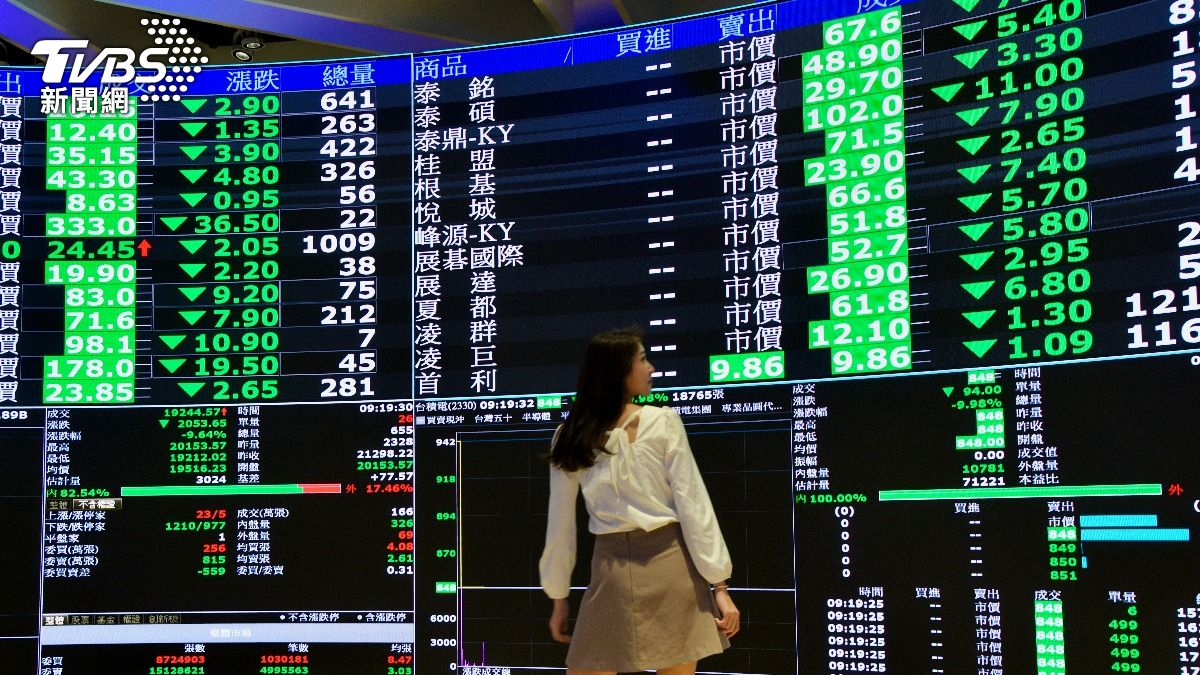
TAIPEI (TVBS News) — Taiwan's stock market suffered a historic collapse on Monday (April 7) as the ripple effects of U.S. President Donald Trump's newly imposed reciprocal tariffs sent shockwaves through global financial markets. The unprecedented sell-off marked the largest single-day point drop and percentage decrease in Taiwan's market history, erasing more than NT$6.6 trillion (around US$199.2 billion) in market value in just hours of trading. Individual investors across the island nation faced devastating losses, with portfolios shrinking by an average of NT$500,000 (US$15,060) as panic selling gripped the export-dependent economy.
The benchmark index plummeted by more than 2,000 points, representing a staggering decline of nearly 10% that triggered circuit breakers and trading limits across the board. Taiwan Semiconductor Manufacturing Company (TSMC, 台積電), the world's largest contract chipmaker and Taiwan's most valuable company, opened NT$94 lower before hitting its limit-down price of NT$848, instantly erasing NT$2.4 trillion (around US$72.3 billion) in market value. The semiconductor giant has now seen its market capitalization shrink by over NT$8 trillion (around US$241 billion) since Jan. 2 as trade tensions escalated. Electronics manufacturing behemoth Hon Hai (鴻海), better known internationally as Foxconn, similarly suffered with shares opening NT$15 lower at NT$138.5, shedding over NT$20 million (around US$602,400) in market value. The bloodbath extended across Taiwan's vital technology sector, with other major stocks including chip designer MediaTek (聯發科) and computer manufacturer Quanta (廣達) also plunging to their daily limit-down prices.
Taiwan Stock Exchange Corporation (TWSE, 證交所) Chairman Sherman Lin (林修銘) acknowledged the island's financial markets' high correlation with international market movements while attempting to calm panicked investors. In a hastily arranged press briefing as trading screens flashed red across the exchange floor, Lin urged market participants to remain cautious and focus on evaluating company fundamentals rather than succumbing to emotional selling. He emphasized that should the irrational market declines continue in the coming days, the exchange stands ready to implement additional stabilization measures in coordination with regulatory policies, though he stopped short of specifying what specific interventions might be deployed.
The Financial Supervisory Commission (FSC, 金管會), Taiwan's top financial regulator, had already implemented several emergency measures a day earlier in anticipation of market turbulence, including strict limitations on investors' short selling activities and substantially raising margin requirements for leveraged positions. These preventive actions, coupled with Premier Cho Jung-tai's (卓榮泰) April 4 announcement of an NT$88 billion (around US$2.65 billion) market rescue package, proved woefully insufficient to stem the tide of selling pressure that overwhelmed Taiwan's markets as traders responded to the new trade reality.