










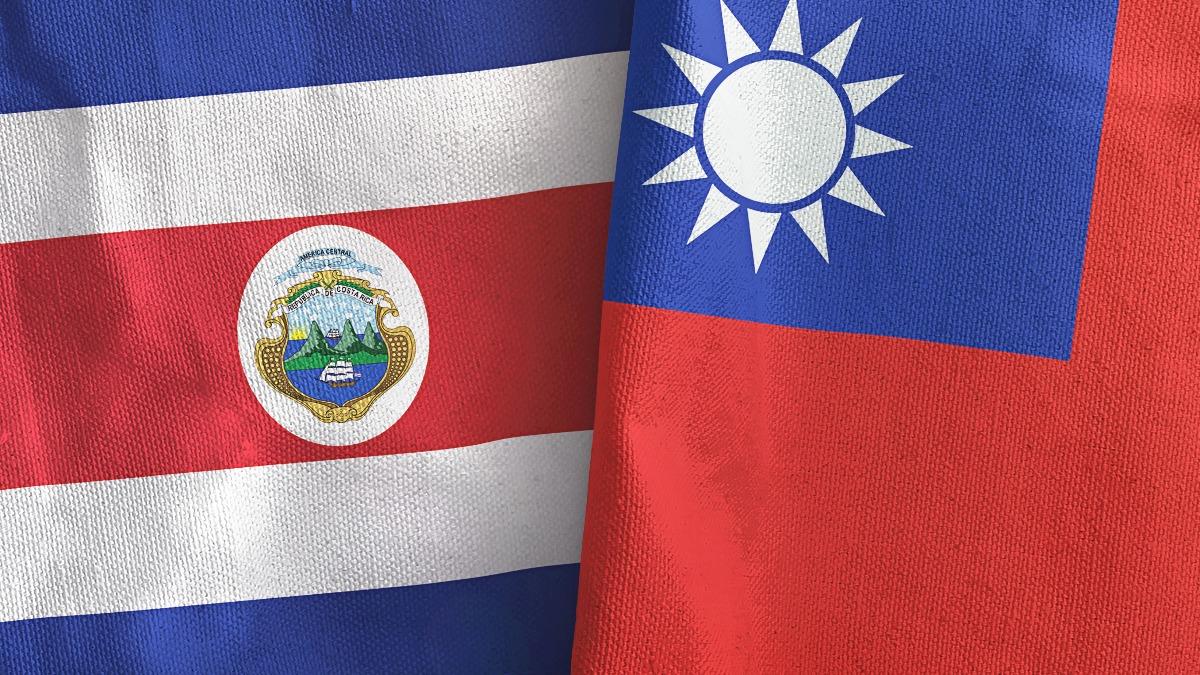
TAIPEI (TVBS News) — Costa Rica has confirmed that its national intelligence agency dispatched five officials to Taiwan for specialized security training last month, signaling a notable shift in relations between the two nations. The Wednesday (June 18) announcement marks the first acknowledged intelligence cooperation since Costa Rica broke diplomatic ties with the self-governing island in favor of China nearly two decades ago. The three-week training program represents a subtle but significant realignment in Central America's approach to cross-strait relations.
According to La Nacion, a prominent Costa Rican newspaper, the intelligence officers' visit spanned from May 8 to 31, with Taiwan shouldering all expenses for the training program. Costa Rica's Presidential Office defended the arrangement as a practical necessity, citing the Directorate of Intelligence and Security's budget constraints that would otherwise prevent such specialized training. In a related development, Foreign Trade Minister Manuel Tovar (托瓦) revealed that Procomer, the country's trade promotion agency, had separately sent two officials to Taiwan with the explicit mission of attracting investment from the island's world-leading semiconductor industry.
Beijing's diplomatic mission in San José issued a sharp rebuke, declaring that the intelligence training arrangement violated the One China policy (一中政策), which recognizes the People's Republic of China as the sole legitimate government of China. The Chinese Embassy categorically opposed any official exchanges between Costa Rica and Taiwan, which China considers a breakaway province. When questioned about these protests during his June 18 press conference, President Rodrigo Chaves sidestepped the diplomatic controversy entirely, instead launching into a pointed critique of Chinese telecommunications giant Huawei, which he accused of improper attempts to sway Costa Rica's judicial system and legislative branch.
The tensions follow Costa Rica's 2023 decision to restrict 5G network development to companies from countries that have signed the Budapest Convention on Cybercrime, effectively excluding Chinese telecommunications firms including Huawei, which subsequently mounted a failed legal challenge against the policy. This technological decoupling reflects a broader diplomatic reorientation under President Chaves, who since his 2022 inauguration has adopted a markedly cooler stance toward Beijing despite formal diplomatic relations. His administration has systematically excluded Chinese companies from critical infrastructure projects while cautiously rebuilding ties with Taiwan, a position that aligns closely with Washington's strategic priorities in the region. ◼