






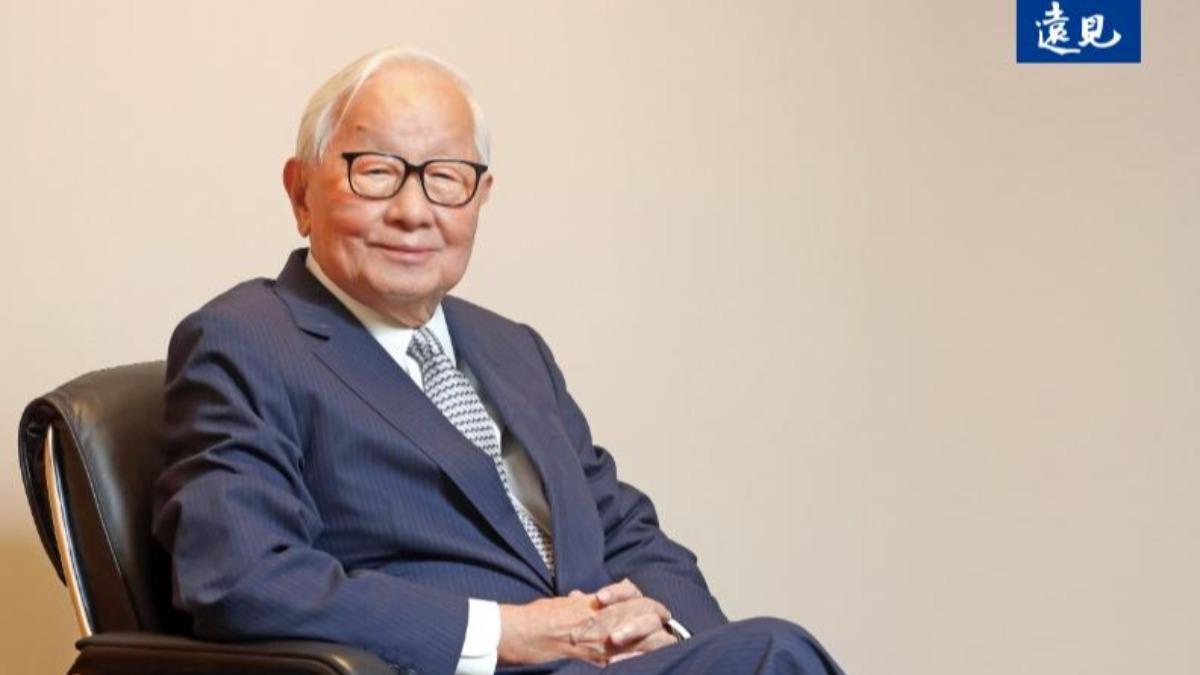
TAIPEI (Global Views Monthly/TVBS News) — Morris Chang (張忠謀), the founder of Taiwan Semiconductor Manufacturing Company (TSMC, 台積電), has been diligently writing since his retirement in 2018. After six years, the second volume of his autobiography has finally been released, 26 years after the first volume. In a recent exclusive interview with Global Views Monthly (遠見雜誌), Chang discussed the writing process, industry secrets, and the founding of TSMC. The nearly 300,000-word manuscript in two volumes, published by Global Views-Commonwealth Publishing Group (天下文化) on Nov. 29, showcases Chang's role as a defining force in the global semiconductor industry. Witness how this titan of Taiwan's semiconductor sector unveils his extraordinary life.
The second volume of "Morris Chang's Autobiography" (張忠謀自傳) is finally available after the first volume was published in 1998. The anticipation was intense, but the writing process proved even more challenging. Chang started writing after his 2018 retirement. The pandemic and health concerns led to intermittent progress. At 93, Chang achieved a nearly 200,000-word volume, spanning 54 years of his life.
"It's done, and I feel relieved!" Chang, known as the "father of Taiwan's semiconductor industry," exclaimed during an interview with Global Views in his Taipei office shared with his wife, Sophie Chang (張淑芬). He expressed no lingering desire to continue writing, even though the second volume only covers up to his 2018 retirement from TSMC. He has no plans for a sequel.
With the publication of his autobiography, Chang has fulfilled his youthful literary dream and might become a bestselling author. Global Views-Commonwealth Publishing Group released both the second volume and a complete set of the autobiography. On the first day of pre-orders, it topped major new book charts and was reprinted three times before release. Industry insiders predict it will create a recent publishing phenomenon based on pre-order and group purchase demand.
Although Chang clarifies in his preface, "This book is my autobiography, not TSMC's history," many eager readers, including tech titans and leaders across sectors, are keen to explore TSMC and the global semiconductor industry's history through Chang's "first-person perspective."
In recent remarks, Chang emphasized that "globalization is dead" and "TSMC has become a battleground," suggesting ongoing challenges ahead. Yet, when queried about these issues, Chang consistently states, "I'm not involved anymore," reflecting his confidence in the succession strategy. His autobiography subtly conveys his pride and hopes for TSMC.
A Candid Confession from the Godfather (of the semiconductor industry): How Does Morris Chang Define Himself?
Over six decades, Chang has shaped the global semiconductor landscape. In his writing, the once-turbulent past now seems tranquil as he strives to reveal his truest self. So, how does he define himself? Below is an excerpt from the exclusive interview with Global Views.
Global Views: How did you select the subjects for your autobiography? Did you find yourself in tears while writing the second volume?
Chang: I wrote both volumes of my autobiography for my own satisfaction. Even without an audience, it wouldn't matter because the process allowed me to relive my life. I chose topics that left a deep impression on me and had a narrative quality. I shed tears while writing the second volume. Many chapters include moments when I cried. Honestly, I was just over 60 when writing the first volume, and I wrote the second from about 87 to 93. There were fewer tears in old age compared to middle age and the most in youth. Though there are fewer tears now, the emotions remain the same.
Global Views: Were there any chapters that were especially difficult to write?
Chang: I avoid writing about them because it's too painful. Writing an autobiography is akin to living through those experiences again, but not everything should be documented. It would be too distressing.
Global Views: In the early years of your career, you joined Texas Instruments (TI, 德州儀器). What was that phase of life like?
Chang: It was an exciting time. I started working in 1955 and learned a lot at Sylvania. Despite Sylvania being in semiconductors, they hired an MIT (麻省理工學院) mechanical engineering master's graduate like me.
The semiconductor industry was in its infancy at the time. The transistor was invented in 1948 at Bell Labs, a division of AT&T at the time. By 1952, AT&T recognized the transistor's significance and decided to license it promptly. TI, a small company back then, had the vision to bid for it. I moved to TI in 1958, marking my first "Rendezvous with Destiny" in the second volume. There are two such rendezvous in my second volume.
Looking Back at 25 Years with TI: 'Ascending the Tower Alone, Seeing the World's End'
Global Views: In your 25 years at TI, you acquired management skills that laid the groundwork for founding TSMC. What do you regard as especially significant?
Chang: I gained most of my knowledge about the semiconductor business and general management at TI. That phase was akin to Yan Shu's (晏殊) Song Dynasty poem, "Ascending the Tower Alone, Seeing the World's End" (獨上高樓,望盡天涯路). Back then, TI was the largest company in the global semiconductor industry! It alone had such a high tower, and I was overseeing TI's semiconductor division. Gazing at the world's end, I understood that TSMC couldn't be a typical IDM (integrated device manufacturer).
Global Views: If you had risen to become TI's CEO, would you have implemented the professional foundry model later used at TSMC?
Chang: I believe that if I had reached the pinnacle at TI, only then could I have made such a decision. There would still be a company like TSMC, but it would be known as "TexaSemi." My tenure at TI was divided into two phases, with 1976 marking a watershed moment. Suddenly, my CEO's attitude toward me shifted. Also, then-Secretary General Fei Hua (費驊) invited me to Taiwan for a speech, and then-Minister Li Kwo-ting (李國鼎) first invited me to advance semiconductors in Taiwan.
In 1985, I traveled to Taiwan. Premier Yu Kuo-hwa (俞國華) was in office then, aiming to establish a semiconductor company. Yu insisted on involving a foreign company with semiconductor expertise, so I reached out to Intel and TI. Had I been TI's CEO, I would have assumed the role later taken by Philips (a major TSMC shareholder).
(Global Views: Would you have invested in TSMC?) Yes!
Three Resignations in Five Years: 'TSMC Was My Sole Option!'
Global Views: Your autobiography notes that you resigned three times over five years. What was your mindset during those times?
Chang: Resignation equates to giving up. I resigned three times because I had no other paths, but this bolstered my determination not to give up again. At 57, I resigned as president of ITRI (工研院). My plan was to work until at least 65, giving me 7-8 more years or possibly longer. Thus, I couldn't afford to give up again. By then, TSMC was my sole option. While TSMC's journey was relatively smooth, it still had its share of challenges.
Global Views: Do you fear that TSMC will encounter major challenges in the future?
Chang: Yes. I recently addressed this at a TSMC event. Trump didn't directly reference TSMC but remarked that Taiwanese companies were capturing U.S. wafer business, embodying "Uneasy lies the head that wears a crown." Of course, Trump hasn't grasped the experience curve yet. Intel is only now coming to understand it, referring to the so-called experience curve.
Global Views: Do you think they haven't fully understood your professional foundry model?
Chang: I believe that's largely the case. The experience curve, or learning curve, is vital. Fundamentally, my most significant general management strategy was the experience curve, which I learned from Bill Bain, who collaborated with me for a year. (Editor's note: Bain & Company, where Bain formulated the "experience curve," is regarded by Chang as TSMC's key to success, suggesting that increased production leads to greater experience and reduced costs.) Recently, I came across an article by a group of former Intel directors advocating for the separation of foundry (晶圓製造) from IC design. A few days later, another former Intel chairman penned an article asserting they should not be separated. I feel that neither group fully comprehends the experience curve I'm referring to.
Indeed, in the chapter "The Temptation of DRAM," I refer to the experience curve, as advised by Lee Kun-hee (李健熙). He suggested that Taiwan lacked sufficient capital and talent, so partnering with Samsung was advisable. This would have made us their subsidiary. However, Samsung's successful experience curve in DRAM has already surpassed ours.
Expressing Genuine Emotions Through Simple Words: Encouraging Readers to Explore the Autobiography
Global Views: Your autobiography discusses your competition and collaboration with Intel. How do you perceive this semiconductor leader?
Chang: This is detailed in the chapter "Apple Knocking at the Door." In 2011, during our negotiations with Apple, they suddenly informed me of a two-month pause due to Intel's interest. I wasn't overly concerned about Apple opting for Intel because, by then, Intel no longer commanded the same reverence it did in the previous century. And indeed, that proved to be true. Another notable moment during that period was when I sought out Apple's COO, Jeff Williams. He remarked, "I'm unavailable, but I've informed my boss, Tim Cook, and you can meet him." I was struck by his ability to defer to his superior. I thought I had such freedom only when working under James Reese, my boss at TI. I envied his relationship with his boss.
Global Views: Hemingway is known for his iceberg theory. Do you also reveal only 1/8 of what's beneath?
Chang: I use simple words and genuine emotions, and that's my sole style. Naturally, I'm not as adept as Hemingway, nor have I practiced. (Global Views: Your grasp of Chinese is strong...) It still needs to be appreciated! I genuinely hope readers will take the time to thoroughly read these two autobiographies. (Compiled by Lin Rang-chun)
Morris Chang: A Game Changer in the Semiconductor Industry
▋English Name: Morris Chang
▋Birth Year: 1931 (Age 93)
▋Education: Attended Harvard University for one year, earned Bachelor's and Master's degrees in Mechanical Engineering from MIT, a Ph.D. in Electrical Engineering from Stanford University, and holds eight honorary doctorates, including one from National Tsing Hua University (國立清華大學)
▋Experience: Held various positions, including General Manager of Texas Instrument's semiconductor group, President and Chairman of ITRI (工研院), Founder of TSMC (台積電), Chairman and CEO of TSMC, and served seven times as APEC's Chinese Taipei leader representative
▋Honors: Received the Republic of China's Order of the Brilliant Star with Grand Cordon, Order of Propitious Clouds with Special Grand Cordon, Order of Dr. Sun Yat-sen, IEEE's Robert N. Noyce Award, and IEEE Medal of Honor, recognized as one of Bloomberg Businessweek's World's Best Managers, one of Time Magazine's 26 Most Influential Managers, and one of Nikkei's Top 20 MVPs in Asia.
For More Reading
This article is excerpted from the December issue of Global Views Magazine; for more articles, please visit the Global Views Magazine website
Here is the link to the Chinese story: 獨家專訪》張忠謀:寫自傳常掉淚,我彷彿重新活過一遍!
More coverage:
1.張忠謀壓箱寶照片曝光!看他如何從青澀少年到寫下半導體傳奇?
2.張忠謀自序:台積電並非一帆風順,我經歷不少酸甜苦辣
3.張忠謀自傳》他對母親最抱憾的事「無法原諒自己那年的不孝」