










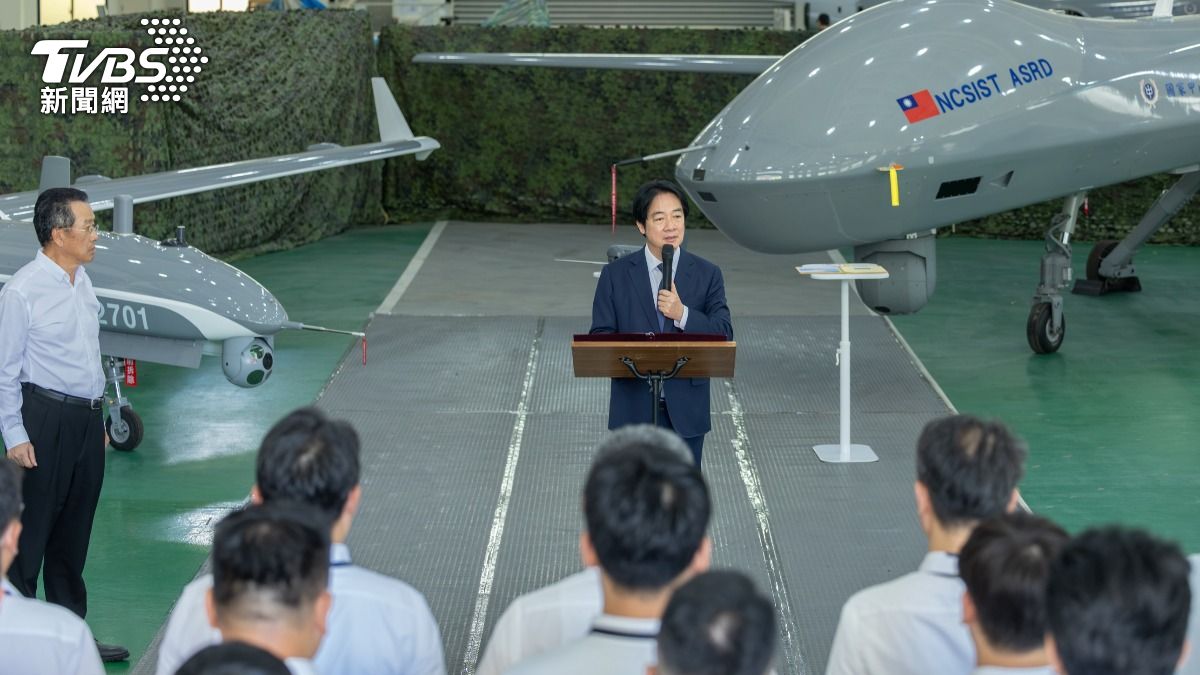
TAIPEI (TVBS News) — President Lai Ching-te (賴清德) on Friday (July 17) urged legislators to pass a NT$210 billion (around US$6.5 billion) military drone budget, accusing opposition parties of treating national security as a "political bargaining chip" and warning that defense officials should not be "trapped in the legislature wasting their time."
Speaking at the National Chung-Shan Institute of Science and Technology (中科院) in Taichung, Lai said Taiwan's drone capabilities are ready to deploy and called on the legislature to approve a special defense budget rather than routing funds through the Ministry of Economic Affairs, as opposition parties have proposed.
"Drones are the most important weapons on the battlefield," Lai said, his voice rising with conviction as he cited the Russia-Ukraine war, the Israel-Hamas conflict, and the ongoing U.S.-Iran confrontation. "They represent asymmetric warfare capabilities."
The visit comes amid a legislative standoff over defense spending. Taiwan's legislature, controlled by opposition parties, previously approved only NT$780 billion (around US$24.2 billion) of an eight-year, NT$1.25 trillion (around US$38.7 billion) special defense budget. The NT$470 billion (around US$14.6 billion) in cuts included the entire drone allocation.
Opposition parties have rejected the cabinet's proposal. The Chinese Nationalist Party (KMT) and Taiwan People's Party (TPP) have drafted competing bills that would place the drone program under the Ministry of Economic Affairs and return funding to the annual budget process, rather than using a special budget mechanism.
"National interests and the safety of people's lives and property cannot be used as bargaining chips for political struggle," Lai said, his frustration evident.
Lai sharply criticized the opposition's alternative bill, quoting Minister of National Defense Wellington Koo (顧立雄): "Money for buying rice and money for buying soy sauce cannot be mixed up." He argued that an economic ministry-led program would be limited to commercial applications, failing to meet military requirements, and noted the cabinet has already allocated NT$44.2 billion (around US$1.37 billion) to the economic ministry for supply chain development.
During his visit, Lai inspected domestically developed systems including the Chien Feng (勁蜂, Mighty Hornet) series, the Rui Yuan II (銳鳶二型, Albatross), and the Teng Yun (騰雲) drone. He said Taiwan's drone technology is now "on par with international standards," with the defense ministry having established a comprehensive warfare framework in collaboration with research institutions.
"Everything is ready — we only lack the east wind," Lai said, invoking a classical Chinese idiom (萬事俱備,只欠東風). "If the legislature supports the defense ministry, the Executive Yuan, and the nation in building a drone attack-and-defense system, I can guarantee the public: I am confident we can safeguard national security and maintain peace and stability in the Indo-Pacific."
The president expressed frustration that Defense Minister Koo has been repeatedly summoned to the legislature, calling these "unnecessary actions" that divert military officials from training and developing combat capabilities.
President Lai insisted defense spending should use a special budget mechanism rather than annual appropriations, arguing military preparedness requires stable, long-term funding. National Security Council Secretary-General Joseph Wu (吳釗燮) and NCSIST President Lee Shih-chiang (李世強) accompanied the president.
Opposition parties have not publicly responded to Lai's remarks. A joint committee of Taiwan's legislature began reviewing the competing drone bills on Thursday, with the Economics Committee taking the lead — a procedural decision that drew criticism from ruling party legislators who argued defense matters should be handled by the Foreign Affairs and National Defense Committee.
"I hope the public can support the nation's development of military drones," Lai said, "and in turn influence the opposition parties to support it as well — so that both ruling and opposition parties can jointly support national security and industrial development, in response to the international community's expectations for Taiwan's commitment to safeguarding security." ◼ (At time of reporting, US$1 equals approximately NT$32.27)