









A mango from Taiwan has traveled over 10,000 kilometers (6,214 miles) to reach Europe. It now sits on shelves at Galeries Lafayette in Paris and Rungis, Europe's largest wholesale market. Priced at NT$2,000 (US$62) per kilogram (2.2 lbs), this is no accident but the hard-won result of five years of effort by Taiwanese farmers and the government.
TAIPEI (Business Today/TVBS News) — "Tell me what you eat, and I will tell you what you are." So wrote French gastronome Jean Anthelme Brillat-Savarin roughly two centuries ago. Paul Bocuse, the Michelin-starred chef hailed as the "God of French Cuisine," echoed this sentiment: "Without good ingredients, there will never be good cooking."
These two quotes reveal the French nation's longstanding devotion to cuisine and quality ingredients. Yet the French, who have always prided themselves on their culinary taste, have recently become captivated by a tropical fruit from ten thousand kilometers away: Taiwan's Irwin mango.
In mid-June, Taiwan's Irwin mangoes officially went on sale at Galeries Lafayette in Paris, the premium produce brand Maison LFL, and other retailers. A one-kilogram (2.2 lbs) package costs 60 euros (NT$2,200) — more than ten times the retail price in Taiwan — yet French consumers are still flocking to buy them. Even residents of Neuilly-sur-Seine, a wealthy Parisian neighborhood comparable to Taipei's Tianmu, were won over after sampling and took boxes home to try.
The Irwin mangoes that have conquered Paris, the "City of Light," come from the humble rural villages of Pingtung.
From Harvest to Takeoff: One to Two Days
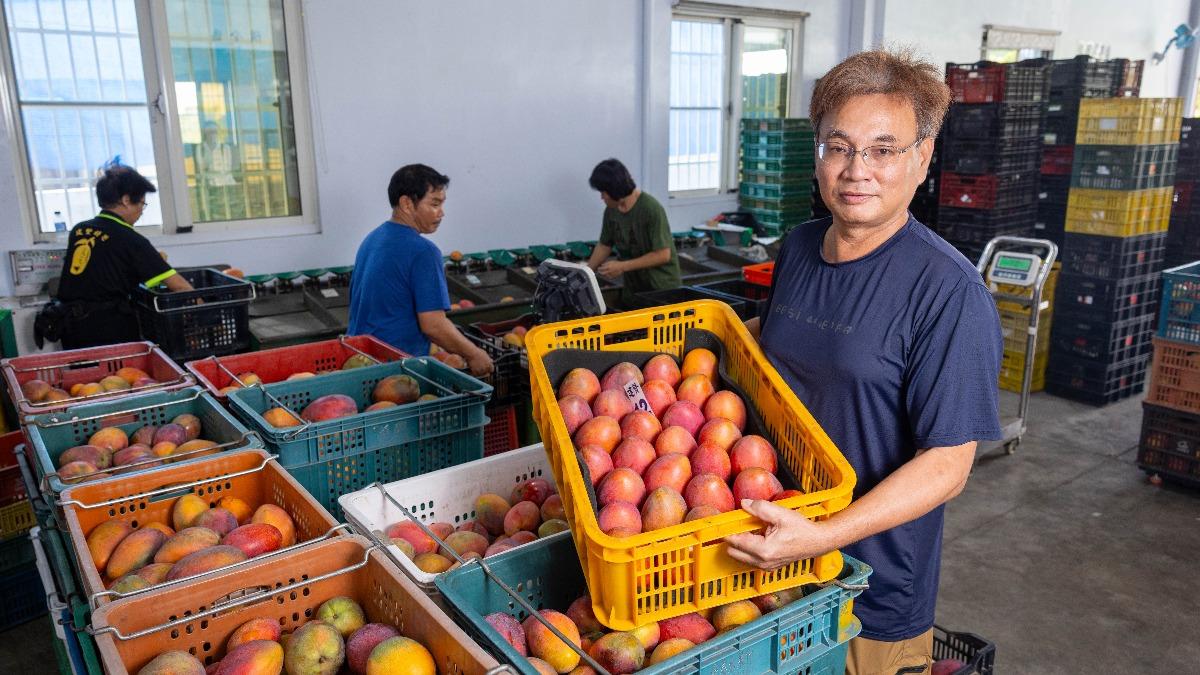
On an early summer morning in June, stepping into the corrugated metal collection center of Jianxian Fruit and Vegetable Marketing Cooperative reveals piles of mangoes stacked like a bright red mountain. The facility sits in Fangshan Township, Pingtung. These mangoes were carefully harvested by farmers at dawn and delivered here. After visual inspection, weight grading, and washing, they are placed in baskets, then immediately loaded onto cold-chain logistics trucks and transported to a nearby vapor heat treatment facility.
Next, the mangoes must pass random pesticide testing. They are then placed in vapor heat treatment boxes and heated at 46.5°C (115.7°F) for 30 minutes to eradicate the Oriental fruit fly. Afterward, they are cooled to 4°C (39.2°F). A second round of screening follows to eliminate any fruit that has deteriorated from the heat treatment.
"Normally, production areas reject about 20 percent as substandard, but this batch rejected 50 to 60 percent. After the heat treatment, another half was rejected," explained Chen Ming-hsien (陳明賢), chairman of Jianxian Cooperative. "The color must be bright red, 90 percent ripe, with a sweetness of at least 12 degrees Brix, and the appearance must be flawless," Chen added. It is this pursuit of perfection that has allowed Irwin mangoes to make a name for themselves in Europe.
After passing through this sauna-like ordeal, the selected "elite produce" is prepared for air freight to Paris. To ensure freshness, all procedures are compressed into one to two days.
The Irwin mango, now shining like a gem on the international stage, faced a serious sales crisis just three years ago.
Since 2005, when the Chinese government opened its market to 15 types of Taiwanese fruit with zero tariffs and simplified customs procedures, Taiwan's mangoes were primarily exported to China. At the peak, total exports exceeded 20,000 metric tons. That all changed in August 2023, when China's General Administration of Customs announced a suspension of imports after detecting scale insects in Taiwanese mangoes.
Mangoes were not the first fruit shut out of China. As early as 2021, Chinese officials banned imports of Taiwanese pineapples, wax apples, and sugar apples, citing failed quarantine inspections. Farmers had mentally prepared for the possibility that "the next one might be me." They began adjusting pesticide use to comply with various countries' quarantine regulations while working with the government to develop markets outside China.
Chen Chi-chung (陳吉仲), who served as Minister of Agriculture at the time, noted that after Taiwan's fruit exports to China were blocked in 2021, the government realized it needed to actively open international markets. Otherwise, domestic oversupply would occur and farmers' incomes would suffer.
At the time, a president of a major Japanese retail chain told him that Japan's wholesale markets maintained stable quality and longer shelf life through full cold-chain transportation, resulting in better prices. The Ministry of Agriculture therefore requested approval from the president and the Executive Yuan, Taiwan's cabinet, to allocate a four-year budget of NT$14 billion (US$435 million) starting in 2021 to build cold-chain infrastructure and lay the groundwork for exports.
When China's ban was announced, Jianxian Cooperative quickly launched home delivery and group purchasing services, hoping to move as much product as possible. The following year, they successfully sold surplus mangoes to Japan and South Korea. But they could not completely stop the financial bleeding. "As soon as the ban came out, the sudden surplus of mangoes had nowhere to go, causing many farmers to suffer heavy losses that year," Chen recalled.
Public-Private Partnership Yields Premium Products
Jianxian Cooperative had actually recognized the export potential of Taiwanese fruit and the need for cold-chain infrastructure even before the government did.
Chen noted that around 2019, to meet the high standards of the Japanese market, he applied for a government subsidy covering half the cost, allowing the cooperative to gradually introduce cold-chain equipment. The subsequent government-led national-level construction completed the last mile of full cold-chain coverage from production areas to the airport.
At the same time, he worked with the Agriculture and Food Agency and the Fengshan Tropical Horticultural Experiment Branch of the Taiwan Agricultural Research Institute to develop the "Lobster Mango." Based on the Irwin mango, this variety uses chitin and calcium from lobster shells as liquid fertilizer. Cultivated entirely in temperature-controlled greenhouses, the method reduces pest damage and pesticide use while enabling automatic watering and spraying. The fruit's skin displays a bright red color resembling a cooked lobster.
"Farmers didn't know how to use temperature-controlled greenhouses at first, and it took two years of trial and error," Chen revealed. During the development of the variety and the cultivation process, resistance was inevitable. But he always worked hard to convince members. "One more export market means one more layer of protection for farmers," he said. Gradually, partners built consensus around this shared goal.
The carefully cultivated Lobster Mango boasts a more vibrant red color than regular Irwin mangoes and a fresher, sweeter taste. It has been available at high-end department stores and supermarkets in Japan since 2024.
"Japan's cold-chain and inspection standards are very strict," Chen Chi-chung said. "If you can reach Japan, you can reach the world, and Taiwanese fruit won't have to rely heavily on a single high-risk market."
Having successfully passed Japan's test, the government and farmers set their sights even further, targeting the European Union market with its equally strong purchasing power.
At the end of 2024, the Bureau of Animal and Plant Health Inspection and Quarantine (BAPHIQ), after extensive preparation, formally submitted scientific data and pest control measures to the EU, applying for permission to import Taiwanese fruit. Mangoes, for example, would undergo vapor heat treatment noted on phytosanitary certificates. After months of review, Europe's doors finally opened in 2025.
While compiling quarantine data, market research proceeded simultaneously.
Taiwan's Representative to France Hao Pei-chih (郝培芝) shared that colleagues at the representative office collected market information from Rungis, Europe's largest fruit and vegetable wholesale market. They observed that mangoes have gradually become a popular cooking ingredient among the French in recent years. The main products on the market mostly come from Africa and Central America. "Taiwan's mangoes are of better quality. If we target high-end channels, there's a good opportunity," she said.
After Taiwan's mangoes obtained official import permission, the representative office immediately connected French importer Sun 7 Fruits with Taiwanese trading company Nature House (自然屋). Nature House then reached out to Jianxian Cooperative, a long-term partner with stable quality, and finalized a deal to bring Taiwan's premium mangoes as a summer feast for Parisians.
"In the past, fruit exports were mostly traders working alone. Now the Ministry of Agriculture is helping make connections, exporting in a more systematic and scalable manner," said Minister of Agriculture Chen Junne-jih (陳駿季). He noted that this mango export involved deep government participation, from distribution channels to marketing. Many other EU countries have already expressed interest, demonstrating that with systematic operations, Taiwanese fruit can flourish in multiple markets.
After receiving the French order in the second half of last year, Jianxian Cooperative immediately began complying with European pesticide regulations, uniformly distributing approved pesticides to cooperating farmers. "When the mangoes grow to about the size of a thumb, we start applying European-standard pesticides," Chen said.
Paris Unboxing Video Draws 100,000 Views in Two Days
Despite absolute confidence in their fruit's quality, cooperative farmers were under immense pressure as they faced a new market for the first time. Only when good news arrived from afar in May could farmers finally relax. The Jianxian Cooperative's LINE group chat buzzed non-stop with excitement. "Everyone was posting links to news reports, very happy and proud," Chen said with a smile.
The enthusiastic response to Taiwan's Irwin mangoes in France rivaled that back home.
Hao excitedly recounted that after the first batch of mangoes arrived in France, she filmed a promotional video with the owner of premium produce brand Maison LFL. Within two days, it garnered 100,000 views. Many influencers spontaneously unboxed and snapped up the mangoes, attracting more and more customers. "The spread on social media was really unexpected," she said.
To date, Jianxian Cooperative has exported more than 6 metric tons of mangoes to Europe. Although this is just a fraction of the annual production of 1,000 metric tons, Chen remains optimistic. "The volume for one country is not much, but if it becomes ten countries, that's 60 tons, and it can benefit many farmers!" he said.
He explained that the export purchase price per mango is often 30 to 40 percent higher than the domestic price, while also avoiding the risk of putting all eggs in one basket. Besides China's sudden import bans, uncertainties such as this year's severe yen depreciation and the sluggish Hong Kong market can affect prices. The more diversified the channels, the more stable farmers' incomes become.
With the concerted efforts of the government and farmers, Taiwan's mangoes have made a name for themselves in France. Chen Junne-jih optimistically predicts that Taiwan's mango exports this year will reach 2.5 times last year's volume. Whether this momentum can continue and make Taiwan's "Fruit Kingdom" reputation shine even brighter remains to be seen. ◼ (At time of reporting, US$1 equaled approximately NT$32.17 and 1 euro equaled approximately NT$36.79)
>>> For More Reading:
This article is excerpted from the No. 1541 issue of Business Today (今周刊). Click here for the Chinese-language version of this story: 屏東農村千日作戰 打進法國高端市場 從滯銷到十倍價輸歐 揭密台灣芒果特攻隊
>>> More Coverage:
01 | 張忠謀95歲生日,魏哲家率台積電高層提前祝壽!夫人團現身神祕壽宴,出席名單揭密、藏世代傳承玄機
02 | 台積電法說來了!寫下最強上半年,毛利率能拚7字頭? 中國DRAM搶市!長鑫科技啟動IPO|今周重磅
03 | 雷虎(8033)、長榮航太(2645)股價飆背後護國祕密!謝金河:無人機產業只能做不能說,大廠一動「對岸電話就打來」
TAIPEI (Business Today/TVBS News) — "Tell me what you eat, and I will tell you what you are." So wrote French gastronome Jean Anthelme Brillat-Savarin roughly two centuries ago. Paul Bocuse, the Michelin-starred chef hailed as the "God of French Cuisine," echoed this sentiment: "Without good ingredients, there will never be good cooking."
These two quotes reveal the French nation's longstanding devotion to cuisine and quality ingredients. Yet the French, who have always prided themselves on their culinary taste, have recently become captivated by a tropical fruit from ten thousand kilometers away: Taiwan's Irwin mango.
In mid-June, Taiwan's Irwin mangoes officially went on sale at Galeries Lafayette in Paris, the premium produce brand Maison LFL, and other retailers. A one-kilogram (2.2 lbs) package costs 60 euros (NT$2,200) — more than ten times the retail price in Taiwan — yet French consumers are still flocking to buy them. Even residents of Neuilly-sur-Seine, a wealthy Parisian neighborhood comparable to Taipei's Tianmu, were won over after sampling and took boxes home to try.
From Harvest to Takeoff: One to Two Days
On an early summer morning in June, stepping into the corrugated metal collection center of Jianxian Fruit and Vegetable Marketing Cooperative reveals piles of mangoes stacked like a bright red mountain. The facility sits in Fangshan Township, Pingtung. These mangoes were carefully harvested by farmers at dawn and delivered here. After visual inspection, weight grading, and washing, they are placed in baskets, then immediately loaded onto cold-chain logistics trucks and transported to a nearby vapor heat treatment facility.
Next, the mangoes must pass random pesticide testing. They are then placed in vapor heat treatment boxes and heated at 46.5°C (115.7°F) for 30 minutes to eradicate the Oriental fruit fly. Afterward, they are cooled to 4°C (39.2°F). A second round of screening follows to eliminate any fruit that has deteriorated from the heat treatment.
After passing through this sauna-like ordeal, the selected "elite produce" is prepared for air freight to Paris. To ensure freshness, all procedures are compressed into one to two days.
The Irwin mango, now shining like a gem on the international stage, faced a serious sales crisis just three years ago.
Since 2005, when the Chinese government opened its market to 15 types of Taiwanese fruit with zero tariffs and simplified customs procedures, Taiwan's mangoes were primarily exported to China. At the peak, total exports exceeded 20,000 metric tons. That all changed in August 2023, when China's General Administration of Customs announced a suspension of imports after detecting scale insects in Taiwanese mangoes.
Mangoes were not the first fruit shut out of China. As early as 2021, Chinese officials banned imports of Taiwanese pineapples, wax apples, and sugar apples, citing failed quarantine inspections. Farmers had mentally prepared for the possibility that "the next one might be me." They began adjusting pesticide use to comply with various countries' quarantine regulations while working with the government to develop markets outside China.
At the time, a president of a major Japanese retail chain told him that Japan's wholesale markets maintained stable quality and longer shelf life through full cold-chain transportation, resulting in better prices. The Ministry of Agriculture therefore requested approval from the president and the Executive Yuan, Taiwan's cabinet, to allocate a four-year budget of NT$14 billion (US$435 million) starting in 2021 to build cold-chain infrastructure and lay the groundwork for exports.
When China's ban was announced, Jianxian Cooperative quickly launched home delivery and group purchasing services, hoping to move as much product as possible. The following year, they successfully sold surplus mangoes to Japan and South Korea. But they could not completely stop the financial bleeding. "As soon as the ban came out, the sudden surplus of mangoes had nowhere to go, causing many farmers to suffer heavy losses that year," Chen recalled.
Public-Private Partnership Yields Premium Products
Jianxian Cooperative had actually recognized the export potential of Taiwanese fruit and the need for cold-chain infrastructure even before the government did.
Chen noted that around 2019, to meet the high standards of the Japanese market, he applied for a government subsidy covering half the cost, allowing the cooperative to gradually introduce cold-chain equipment. The subsequent government-led national-level construction completed the last mile of full cold-chain coverage from production areas to the airport.
At the same time, he worked with the Agriculture and Food Agency and the Fengshan Tropical Horticultural Experiment Branch of the Taiwan Agricultural Research Institute to develop the "Lobster Mango." Based on the Irwin mango, this variety uses chitin and calcium from lobster shells as liquid fertilizer. Cultivated entirely in temperature-controlled greenhouses, the method reduces pest damage and pesticide use while enabling automatic watering and spraying. The fruit's skin displays a bright red color resembling a cooked lobster.
"Farmers didn't know how to use temperature-controlled greenhouses at first, and it took two years of trial and error," Chen revealed. During the development of the variety and the cultivation process, resistance was inevitable. But he always worked hard to convince members. "One more export market means one more layer of protection for farmers," he said. Gradually, partners built consensus around this shared goal.
The carefully cultivated Lobster Mango boasts a more vibrant red color than regular Irwin mangoes and a fresher, sweeter taste. It has been available at high-end department stores and supermarkets in Japan since 2024.
"Japan's cold-chain and inspection standards are very strict," Chen Chi-chung said. "If you can reach Japan, you can reach the world, and Taiwanese fruit won't have to rely heavily on a single high-risk market."
Having successfully passed Japan's test, the government and farmers set their sights even further, targeting the European Union market with its equally strong purchasing power.
At the end of 2024, the Bureau of Animal and Plant Health Inspection and Quarantine (BAPHIQ), after extensive preparation, formally submitted scientific data and pest control measures to the EU, applying for permission to import Taiwanese fruit. Mangoes, for example, would undergo vapor heat treatment noted on phytosanitary certificates. After months of review, Europe's doors finally opened in 2025.
While compiling quarantine data, market research proceeded simultaneously.
Taiwan's Representative to France Hao Pei-chih (郝培芝) shared that colleagues at the representative office collected market information from Rungis, Europe's largest fruit and vegetable wholesale market. They observed that mangoes have gradually become a popular cooking ingredient among the French in recent years. The main products on the market mostly come from Africa and Central America. "Taiwan's mangoes are of better quality. If we target high-end channels, there's a good opportunity," she said.
After Taiwan's mangoes obtained official import permission, the representative office immediately connected French importer Sun 7 Fruits with Taiwanese trading company Nature House (自然屋). Nature House then reached out to Jianxian Cooperative, a long-term partner with stable quality, and finalized a deal to bring Taiwan's premium mangoes as a summer feast for Parisians.
"In the past, fruit exports were mostly traders working alone. Now the Ministry of Agriculture is helping make connections, exporting in a more systematic and scalable manner," said Minister of Agriculture Chen Junne-jih (陳駿季). He noted that this mango export involved deep government participation, from distribution channels to marketing. Many other EU countries have already expressed interest, demonstrating that with systematic operations, Taiwanese fruit can flourish in multiple markets.
After receiving the French order in the second half of last year, Jianxian Cooperative immediately began complying with European pesticide regulations, uniformly distributing approved pesticides to cooperating farmers. "When the mangoes grow to about the size of a thumb, we start applying European-standard pesticides," Chen said.
Paris Unboxing Video Draws 100,000 Views in Two Days
Despite absolute confidence in their fruit's quality, cooperative farmers were under immense pressure as they faced a new market for the first time. Only when good news arrived from afar in May could farmers finally relax. The Jianxian Cooperative's LINE group chat buzzed non-stop with excitement. "Everyone was posting links to news reports, very happy and proud," Chen said with a smile.
The enthusiastic response to Taiwan's Irwin mangoes in France rivaled that back home.
Hao excitedly recounted that after the first batch of mangoes arrived in France, she filmed a promotional video with the owner of premium produce brand Maison LFL. Within two days, it garnered 100,000 views. Many influencers spontaneously unboxed and snapped up the mangoes, attracting more and more customers. "The spread on social media was really unexpected," she said.
To date, Jianxian Cooperative has exported more than 6 metric tons of mangoes to Europe. Although this is just a fraction of the annual production of 1,000 metric tons, Chen remains optimistic. "The volume for one country is not much, but if it becomes ten countries, that's 60 tons, and it can benefit many farmers!" he said.
He explained that the export purchase price per mango is often 30 to 40 percent higher than the domestic price, while also avoiding the risk of putting all eggs in one basket. Besides China's sudden import bans, uncertainties such as this year's severe yen depreciation and the sluggish Hong Kong market can affect prices. The more diversified the channels, the more stable farmers' incomes become.
With the concerted efforts of the government and farmers, Taiwan's mangoes have made a name for themselves in France. Chen Junne-jih optimistically predicts that Taiwan's mango exports this year will reach 2.5 times last year's volume. Whether this momentum can continue and make Taiwan's "Fruit Kingdom" reputation shine even brighter remains to be seen. ◼ (At time of reporting, US$1 equaled approximately NT$32.17 and 1 euro equaled approximately NT$36.79)
>>> For More Reading:
This article is excerpted from the No. 1541 issue of Business Today (今周刊). Click here for the Chinese-language version of this story: 屏東農村千日作戰 打進法國高端市場 從滯銷到十倍價輸歐 揭密台灣芒果特攻隊
>>> More Coverage:
01 | 張忠謀95歲生日,魏哲家率台積電高層提前祝壽!夫人團現身神祕壽宴,出席名單揭密、藏世代傳承玄機
02 | 台積電法說來了!寫下最強上半年,毛利率能拚7字頭? 中國DRAM搶市!長鑫科技啟動IPO|今周重磅
03 | 雷虎(8033)、長榮航太(2645)股價飆背後護國祕密!謝金河:無人機產業只能做不能說,大廠一動「對岸電話就打來」