










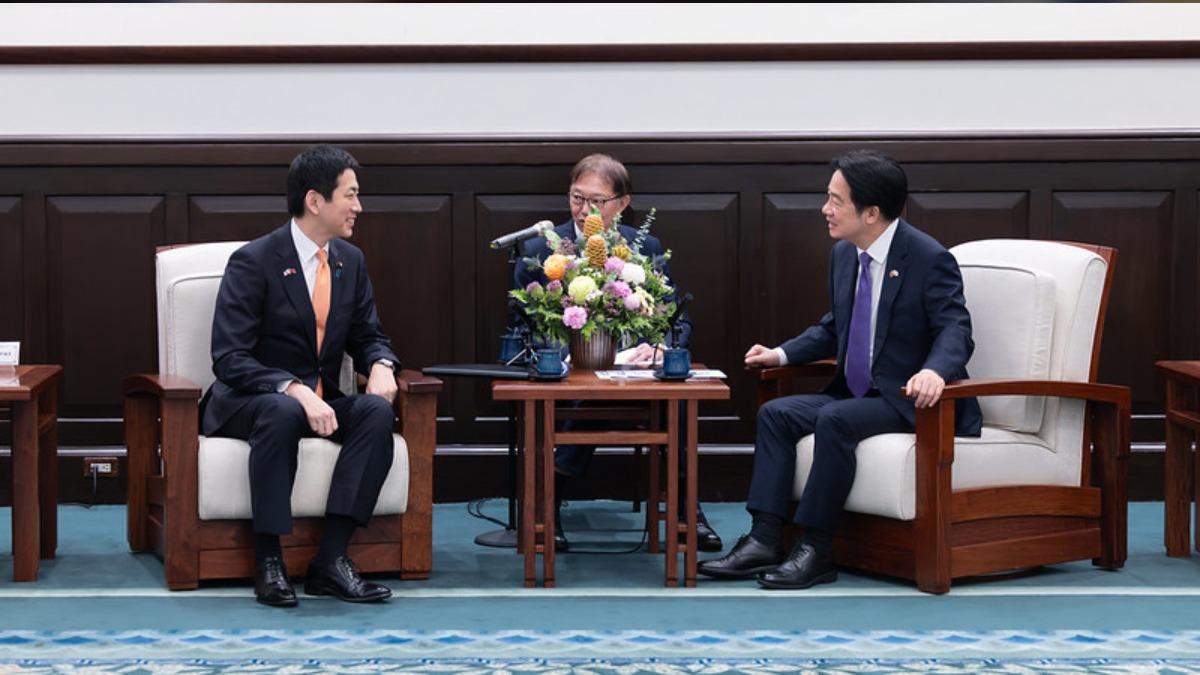
TAIPEI (TVBS News) — Taiwan's president and a prominent Japanese politician pledged on Thursday (June 26) to strengthen economic cooperation between democratic nations as concerns mount over China's growing influence in global supply chains. President Lai Ching-te (賴清德) welcomed Kobayashi Takayuki (小林鷹之), Japan's former Minister for Economic Security, to the presidential office in Taipei for discussions centered on bolstering what officials termed the "non-red supply chain" (非紅供應鏈), a network of trade relationships explicitly designed to exclude Chinese influence. The high-level meeting reflects growing anxiety among democratic nations about economic dependencies on China, which both leaders characterized as potentially threatening to international trade systems.
The meeting was attended by Taiwan's highest-ranking national security officials, underscoring its strategic importance. President Lai was joined by Pan Meng-an (潘孟安), secretary-general of the Office of the President, Joseph Wu (吳釗燮), secretary-general of the National Security Council, Lin Chia-lung (林佳龍), minister of Foreign Affairs, and Ma Yung-chen (馬永成), minister without portfolio. During the discussions, President Lai highlighted Kobayashi's extensive expertise in economic security matters, technological development, and space policy, while noting the Japanese politician's significant role in Japan's Liberal Democratic Party presidential election last year. This visit marks Kobayashi's first trip to Taiwan since 2018.
During the talks, Kobayashi reaffirmed Japan's opposition to Taiwan's diplomatic isolation and advocated for substantive discussions on practical measures to develop alternative supply chains independent of Chinese influence. The former minister emphasized the strategic value of bilateral cooperation between Taiwan and Japan, while also suggesting the potential benefits of trilateral coordination that would include the United States. In response, President Lai conveyed his appreciation to Japan's leadership across multiple administrations, specifically naming former Prime Ministers Shinzo Abe (安倍晉三), Yoshihide Suga (菅義偉), and Fumio Kishida (岸田文雄), as well as current Prime Minister Shigeru Ishiba (石破茂), for their consistent support of regional stability in the Taiwan Strait.
Looking toward future economic cooperation, President Lai called for expedited negotiations on a comprehensive Economic Partnership Agreement (EPA) between Taiwan and Japan that would strengthen trade relations and encourage cross-border investment. The Taiwanese leader also sought Japan's backing for Taiwan's long-standing bid to join the Comprehensive and Progressive Agreement for Trans-Pacific Partnership (CPTPP), a major regional trade pact that includes Japan among its 11 member nations. Taiwan's admission to the CPTPP would represent a significant diplomatic achievement for the democratically governed island and bolster its economic security in a region increasingly dominated by Chinese influence. ◼