









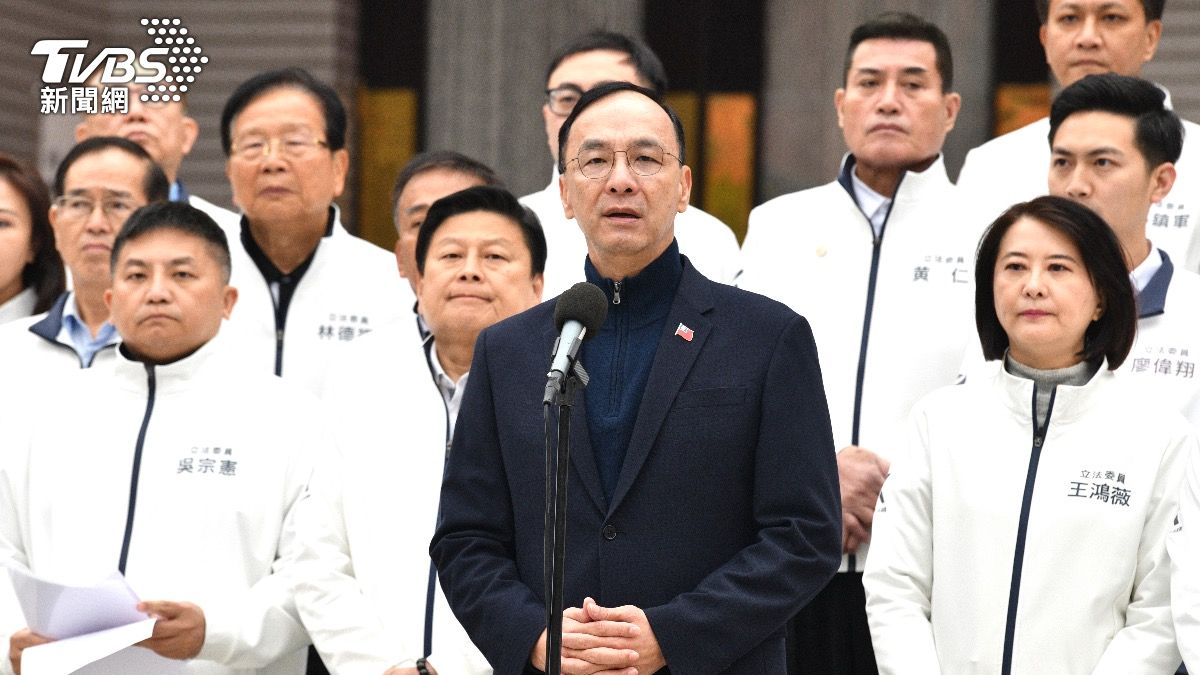
TAIPEI (TVBS News) — The head of Taiwan's main opposition party lambasted President Lai Ching-te's (賴清德) response to U.S. President Donald Trump's threatened 32% tariff on Taiwanese imports as "overly naive." Speaking on Sunday (April 6), Kuomintang (KMT, 國民黨) Chairman Eric Chu (朱立倫) emphasized his party's serious concerns about the potential economic fallout from the tariff dispute that has sent shockwaves through Taiwan's export-dependent economy.
Chu announced that KMT leadership would attend the cross-party meeting scheduled for Monday (April 7), where they would demand the ruling Democratic Progressive Party present a concrete emergency response plan. He dismissed the NT$88 billion (approximately US$2.65 billion) subsidy package implemented by the Executive Yuan (Taiwan's cabinet), characterizing it as woefully inadequate for addressing the economic threat. The opposition leader also questioned the wisdom of appointing the Executive Yuan's vice premier to lead the high-stakes negotiations with U.S. officials.
Following his broad criticisms of the government's response strategy, Chu articulated five major concerns regarding Taiwan's approach to the tariff crisis. Chief among these was the need for the Lai administration to clearly articulate specific negotiation goals with the United States. He pressed for clarity on whether balancing the U.S. trade deficit with Taiwan was the primary objective of these talks. Chu also expressed skepticism about the government's push for Taiwanese companies to increase investments in the United States, arguing that such a consequential economic policy shift should require cross-party consensus rather than unilateral action.
Highlighting Taiwan Semiconductor Manufacturing Company's (TSMC, 台積電) already substantial commitments to U.S. investment, Chu warned that pressuring the semiconductor giant to further increase its American footprint could be interpreted as government capitulation to U.S. demands. He cautioned that such moves might undermine public confidence in Taiwan's strategic "silicon shield" approach, which positions the island's semiconductor prowess as a key element of its economic and geopolitical security in the face of regional tensions.
Chu sharply criticized the government's mid-to-long-term economic measures as nothing more than a repackaging of routine business operations, failing to provide the public with assurance of a comprehensive strategy to address the tariff threat. In particularly pointed remarks, he dismissed the Financial Regulatory Commission's (金管會) three "market rescue" measures as mere "tranquilizers" that could not possibly address the fundamental economic impact of the trade dispute. These measures, he argued, would only distort normal market mechanisms without solving the underlying problems.
Furthermore, Chu urged President Lai to fundamentally reassess the government's tariff response strategy in light of the serious economic threats facing Taiwan. He emphasized that the KMT stands ready to engage in constructive dialogue with the administration to find the best possible solution for Taiwan's economic interests, suggesting that a unified cross-party approach would strengthen the island's negotiating position with Washington.
On April 2, U.S. President Donald Trump announced a sweeping 32% tariff on Taiwanese imports, sending shockwaves through the island's export-dependent economy. In response, President Lai Ching-te (賴清德) declared on April 6 that Taiwan would not pursue retaliatory tariffs against American goods. Instead, Lai outlined plans to introduce five alternative response strategies designed to mitigate economic damage while maintaining positive trade relations with the United States.