










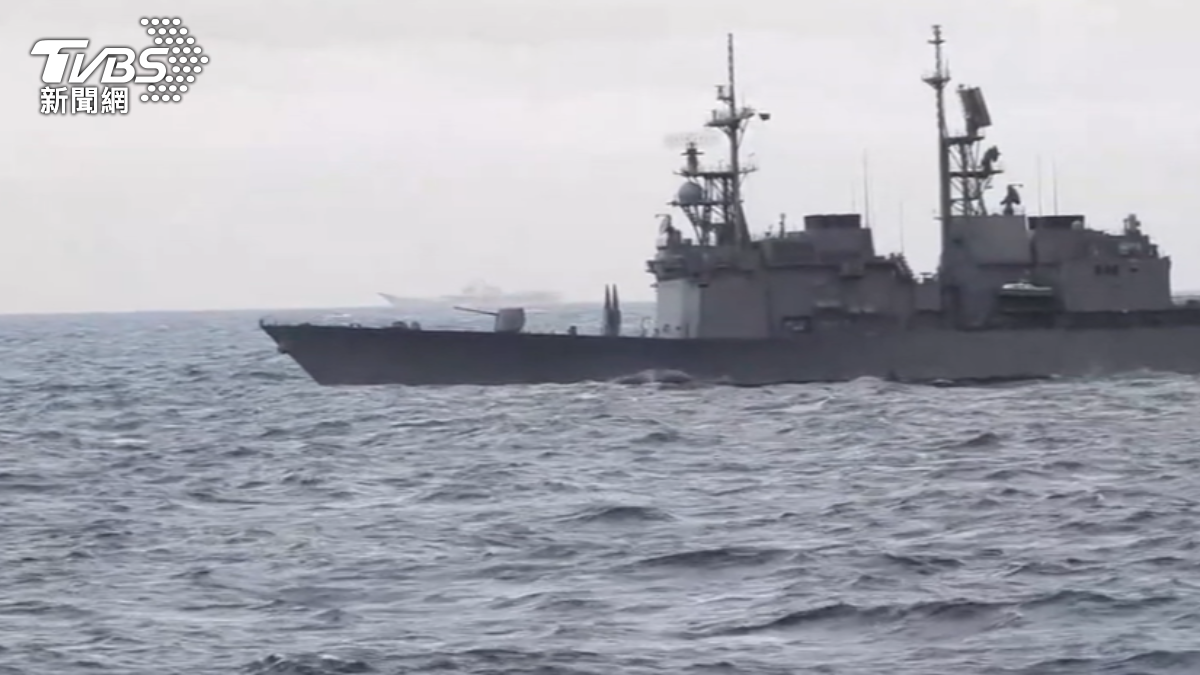
TAIPEI (TVBS News) — China launched a large-scale military drill around Taiwan on Tuesday (April 1), encircling the island democracy with an imposing array of naval vessels and aircraft in what Beijing characterizes as a "serious warning" against what it views as Taiwan independence forces. The dramatic escalation comes amid already heightened tensions across the Taiwan Strait, marking one of the most significant shows of military force in the region in recent months.
The exercise, dubbed "Strait Thunder-2025A," involved a substantial military presence of 71 aircraft sorties, 13 naval vessels, and four coast guard ships over the past 24 hours, according to Taiwan's Ministry of National Defense (MND, 國防部). Military analysts note that the drill specifically focuses on developing capabilities for "verification, identification, warning, repelling, and interception" — tactical elements that would be crucial in any potential blockade scenario.
China's Eastern Theater Command, which oversees military operations facing Taiwan, announced that the exercise strategically positioned in the central and southern Taiwan Strait aims to test Beijing's capabilities for regional control, joint blockade, and precision strikes. The People's Liberation Army Daily (解放軍報), the official newspaper of China's military, explicitly linked the timing of these maneuvers to President Lai Ching-te's (賴清德) 17-point strategy that the newly inaugurated Taiwanese leader proposed in March.
In a calculated diplomatic offensive accompanying the military maneuvers, the Chinese Embassy in the United States shared a provocative map on Facebook depicting Chinese naval vessels completely encircling Taiwan. The post included unambiguous text declaring: "The drills are a serious warning and an act of containment against 'Taiwan independence' separatist forces, and a legitimate and necessary move to defend national sovereignty and uphold national unity. The historical trend that China will and must achieve reunification is unstoppable."
In its coverage, CCTV also sharply criticized President Lai for allegedly "demonizing" China (the People's Republic of China) and issued demands that the Democratic Progressive Party (DPP, 民進黨), Taiwan's ruling party known for its pro-independence leanings, cease what Beijing characterizes as provocations to "prevent panic among Taiwanese citizens." The messaging represents a continuation of China's longstanding position that Taiwan's current government is responsible for deteriorating cross-strait relations.
In a swift and decisive response to China's military posturing, the United States has mobilized significant naval assets toward the region. Chief Pentagon Spokesman Sean Parnell issued a formal statement on April 1 announcing the strategic repositioning of multiple carrier strike groups, signaling Washington's readiness to counter any potential escalation. The timing of the announcement, coming just before China's drills began, suggests a coordinated American effort to demonstrate resolve in the face of Beijing's show of force.
"In line with the President's direction to achieve peace through strength, the Secretary of Defense directed the Harry S. Truman Carrier Strike Group to remain in the U.S. Central Command area of responsibility," Parnell said in the statement. "Following completion of a scheduled exercise in the Indo-Pacific region, the Carl Vinson Carrier Strike Group will arrive in CENTCOM AOR." The latter encompasses a strategic region spanning from Northeast Africa through the Middle East to Central Asia. The deployment of these massive naval battle groups represents one of the most significant shows of American military presence in recent months.
Also, the Pentagon statement revealed that the Nimitz Strike Group has begun deployment to the Western Pacific "to preserve our warfighting advantage in the Indo-Pacific." The comprehensive American response also includes the deployment of "additional squadrons and other air assets" to reinforce defensive capabilities across the region. Military analysts note that the positioning of three carrier strike groups represents an extraordinary commitment of naval power.
In a parallel diplomatic response, U.S. State Department spokesperson Tammy Bruce issued a separate statement delivering pointed criticism of China's military maneuvers. "China's aggressive military activities and rhetoric toward Taiwan only serve to exacerbate tensions and put the region's security and the world's prosperity at risk," Bruce said, reflecting Washington's growing concern about the potential for miscalculation in the increasingly militarized Taiwan Strait.
Bruce further reaffirmed America's unwavering commitment to its network of allies and partners in the region, including Taiwan, stating: "The United States supports peace and stability across the Taiwan Strait and opposes unilateral changes to the status quo, including through force or coercion." The statement represents a continuation of Washington's longstanding policy of strategic ambiguity while signaling robust support for Taiwan's security in the face of increasing pressure from Beijing.