










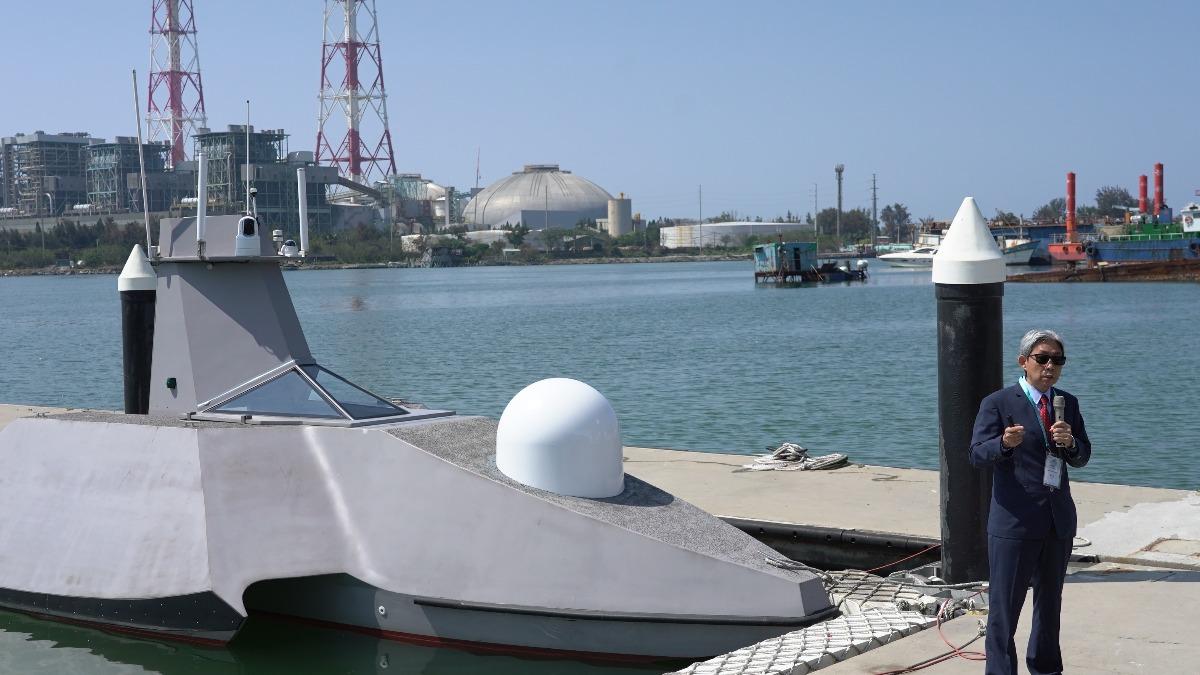
KAOHSIUNG (TVBS News) — Taiwan's premier shipbuilder has unveiled a cutting-edge autonomous naval vessel that could transform the island's defensive capabilities. CSBC Corp., Taiwan (台船公司) presented its indigenously developed unmanned watercraft on Tuesday (March 25) at a high-profile demonstration in Kaohsiung (高雄), emphasizing the vessel's significant asymmetric warfare applications. The sleek trimaran measures 8.6 meters in length and 3.7 meters in width, boasting an impressive payload capacity exceeding 1 ton and a maximum speed surpassing 35 knots. Military analysts noted the craft's explicit design purpose: conducting coordinated swarm attacks against Chinese amphibious assault ships that would be deployed in any potential cross-strait invasion scenario.
The advanced maritime platform's capabilities were displayed through both digital simulation and a live demonstration at Xingda Port (興達港) in Kaohsiung's industrial maritime district. During the water trials, the unmanned vessel exhibited remarkable maneuverability and reached speeds of 30 knots while executing complex navigation patterns. A key safety feature highlighted during the demonstration was the vessel's ability to automatically return to its launch point if communication links are severed — a critical failsafe for combat operations. CSBC Chairman Cheng-Hung Huang (黃正弘) specifically highlighted the strategic advantages of the trimaran hull configuration, which provides exceptional stability and operational resilience in the notoriously challenging conditions of the Taiwan Strait.
The unmanned vessel represents Taiwan's growing emphasis on asymmetric warfare strategies, which company officials described as maximizing "low loss, high efficiency" combat outcomes. These autonomous platforms can be equipped with various high-speed attack capabilities specifically engineered to target larger, more valuable enemy vessels — multiplying Taiwan's defensive power without risking personnel. Engineers incorporated practical deployment considerations into the design, including a collapsible antenna system that enables the vessels to be transported using ordinary pickup trucks or trailers. This mobility feature allows for rapid distribution to various ports and beach locations throughout Taiwan's coastline, creating a dispersed and resilient defensive network.
The current generation of vessels operates through fixed remote control stations, but CSBC has outlined an ambitious development roadmap for the system. Future iterations will include vehicle-mounted, ship-based, and highly portable control stations integrated with high-orbit satellite navigation systems for precise guidance across Taiwan's maritime defense zones. In his technical briefing, Chairman Huang revealed the program's most significant forthcoming advancement: a sophisticated swarm control system capable of coordinating up to 100 unmanned vessels simultaneously. This technology would enable devastating saturation attacks that could overwhelm even the most advanced enemy defensive systems through sheer numerical advantage.