








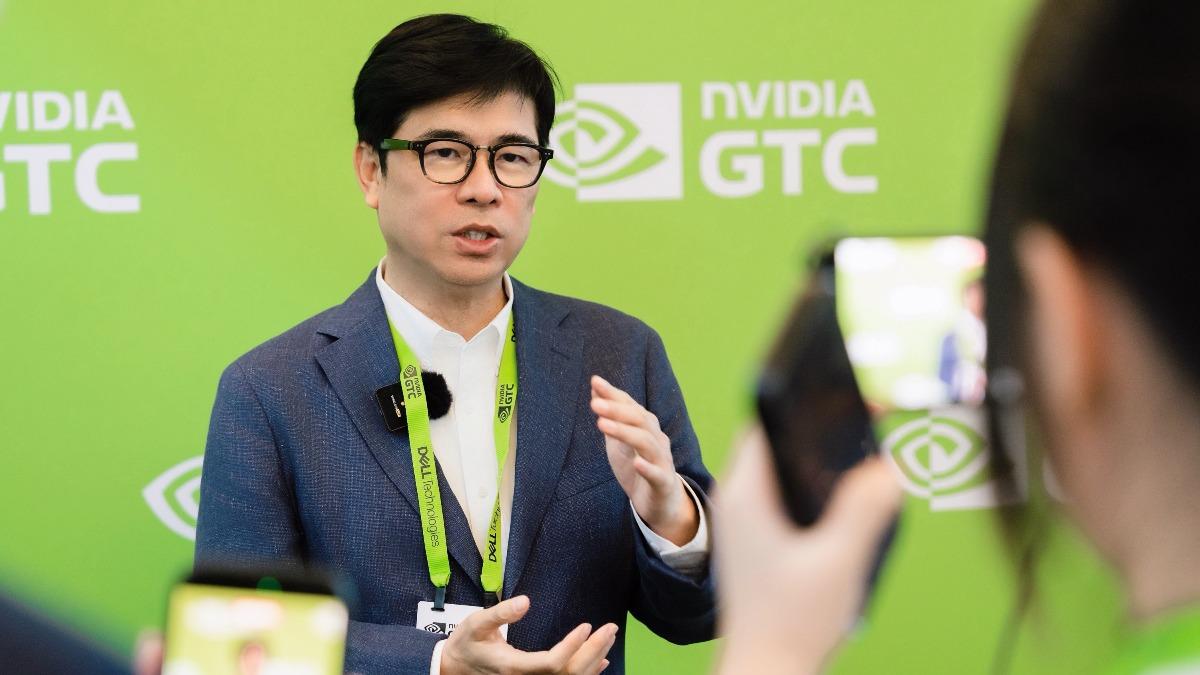
TAIPEI (TVBS News) — Kaohsiung Mayor Chen Chi-mai (陳其邁) attended Nvidia's annual GTC conference in San Jose, California, becoming the only Taiwan city leader invited for two consecutive years. During his March visit, Chen emphasized that computational power serves as a core measure of competitiveness as generative AI enters the "inference era." Kaohsiung, Taiwan's second-largest city and a major industrial hub, is positioning itself at the forefront of AI development.
Chen highlighted Kaohsiung's plans to collaborate with international tech giants to drive industrial and urban transformation. The mayor noted that future software services will pivot around "AI factories," enabling AI to actively analyze and make decisions across transportation, smart manufacturing, and city management. These AI factories represent a new paradigm where artificial intelligence systems operate autonomously to process data and generate insights.
Nvidia CEO Jensen Huang (黃仁勳), a Taiwanese-American executive, stated in his keynote at the 2026 GTC that AI is rapidly evolving into an era dominated by inference and agentic AI, which possesses autonomous planning capabilities. Huang announced the integration of the Groq 3 language processing unit into Nvidia's product lineup, designed to accelerate large language model inferences. The announcement signals Nvidia's continued push to dominate the AI hardware market.
Kaohsiung leads the development of "sovereign AI," a concept focusing on data autonomy and technological innovation that allows cities to maintain control over their AI infrastructure. The city has made significant progress and is the first to implement Nvidia's Cosmos Reason 2 inference model. Kaohsiung Economic Development Bureau Director Liao Tai-Hsiang (廖泰翔) identified "silicon photonics" as key to overcoming AI bandwidth limitations, noting Kaohsiung's resources, including TSMC's advanced processes and AMD's silicon photonics R&D capabilities.