








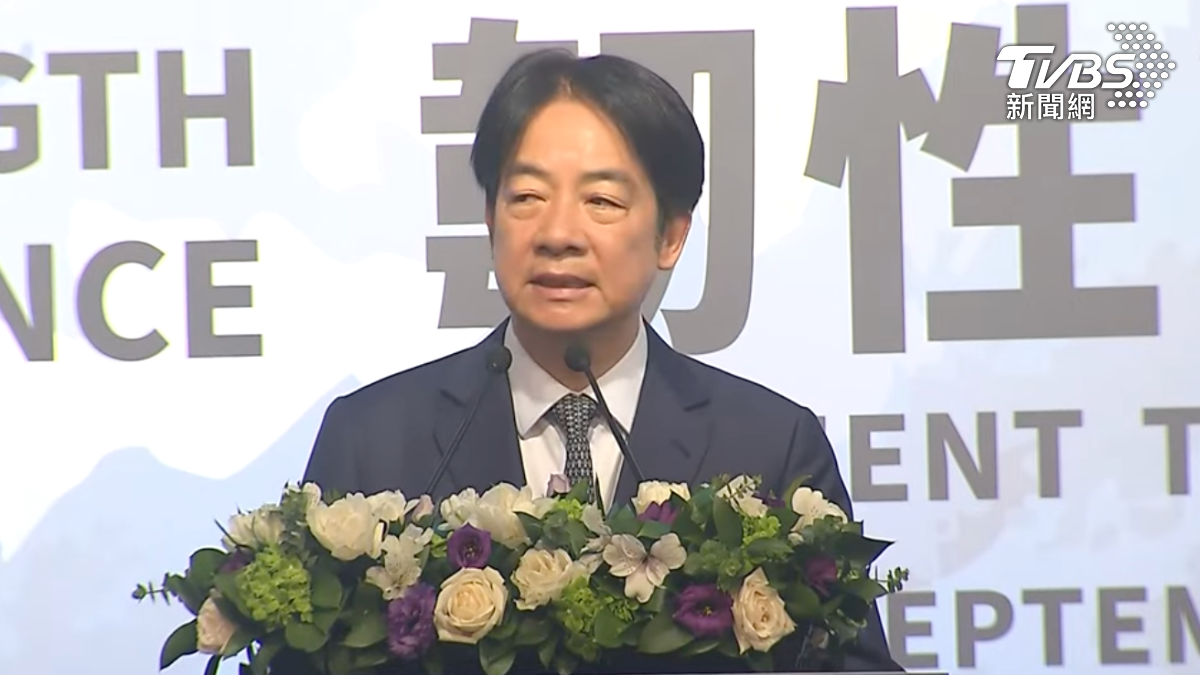
TAIPEI (TVBS News) — President Lai Ching-te (賴清德) announced Saturday (Sept. 20) major defense spending increases to counter regional threats, declaring that any surrender reports during military aggression would constitute disinformation. President spoke at a forum marking Taiwan's Whole-of-Society Defense Committee's (全社會防衛韌性委員會) first anniversary, emphasizing the island democracy's commitment to coordinated military and civilian defense preparations. The committee integrates defense efforts across all government levels and civilian sectors.
Speaking at the National Defense Resilience International Forum (防衛韌性國際論壇), Lai announced Taiwan will increase defense spending to 3.32% of GDP next year, targeting 5% by 2030. The island democracy allocated NT$150 billion (around US$5 billion) for national resilience enhancement, covering civilian defense infrastructure and emergency preparedness systems. International experts attended the forum focused on democratic resilience strategies.
"Peace cannot be entrusted to the goodwill of aggressors," Lai said as commander-in-chief of Taiwan's Armed Forces. He emphasized that avoiding war requires "continuous preparation, strengthening defense capabilities, and social resilience." The president spoke amid rising regional tensions with mainland China, the People's Republic of China, which claims sovereignty over the self-governing island democracy.
The president emphasized Taiwan faces danger because "our proud defense of a free and democratic way of life is incompatible with the ambitions of authoritarian aggressors." He specifically referenced mainland China, the People's Republic of China, as leading a threat camp strengthening alliances against democratic societies. Taiwan operates as a self-governing democracy while Beijing claims sovereignty over the island.
Taiwan's Ministry of National Defense (國防部) released a new All-Out Defense Handbook titled "When Crisis Comes" (當危機來臨時) last week. The handbook, distributed through text messages on National Disaster Prevention Day, explicitly states surrender information during military aggression would constitute disinformation. The manual provides civilians with emergency preparedness guidelines and survival instructions during potential conflicts.
Lai noted European countries, including Norway, France, and Sweden, are accelerating defense preparations and publishing national security manuals. Taiwan's approach follows similar whole-of-society resilience building patterns among democratic nations facing security challenges. The strategy integrates civilian and military preparedness across all sectors of society, from government agencies to private enterprises.
"I believe that the more united we are, the more resilient our nation becomes," Lai said, emphasizing Taiwan's commitment to defending democracy. The president stressed authoritarian preparations aim for military expansion while Taiwan's preparations maintain peaceful status quo. The self-governing island democracy faces increasing military pressure from Beijing, which has never ruled Taiwan but claims sovereignty over it. ◼ (At time of reporting, US$1 equals approximately NT$30)