







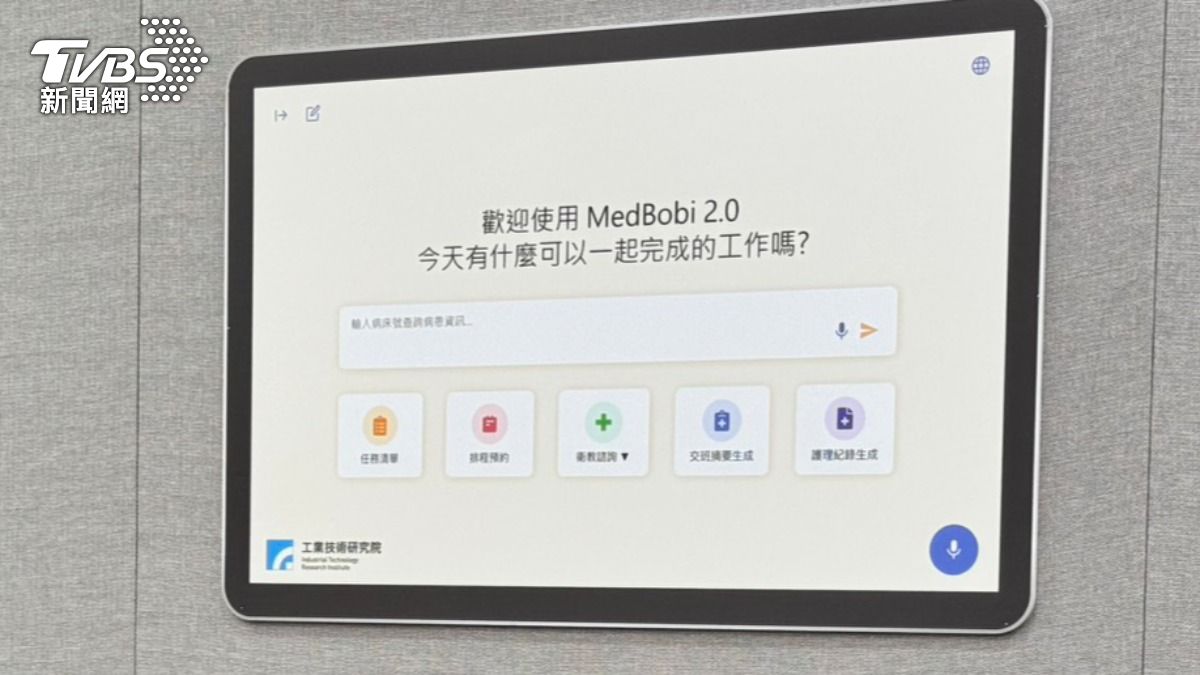
TAIPEI (TVBS News) — The Industrial Technology Research Institute (ITRI, 工研院), Taiwan's leading technology research and development institution, unveiled "MediBobi 2.0" on Monday (July 21), an advanced medical assistant system powered by generative artificial intelligence. The platform represents Taiwan's first innovative medical solution specifically designed around commonly used clinical communication languages and specialized AI model training for healthcare applications.
Eric Y. Chuang (莊曜宇), who directs ITRI's Biomedical Technology and Device Research Laboratories, emphasized the significant improvements in the platform's capabilities as it evolves to version 2.0. The system has already demonstrated its effectiveness at Far Eastern Memorial Hospital (亞東醫院), one of Taiwan's major medical facilities, and has now expanded its implementation to additional medical centers across the country. According to Chuang, internal testing has yielded "impressive" results, with the system achieving a "90% accuracy rate" in diagnostic assistance and clinical judgment scenarios.
The enhanced MediBobi 2.0 system now operates in partnership with four major Taiwanese healthcare institutions: Far Eastern Memorial Hospital, Kaohsiung Veterans General Hospital (高雄榮總) in southern Taiwan, Chung Shan Medical University Hospital (中山附醫), and Chi Mei Hospital (奇美醫院). The AI-powered platform can analyze patient descriptions in their native languages to predict potential diseases and helps medical personnel rapidly generate comprehensive handover reports. The system supports an impressive 96 different languages while maintaining a 90% accuracy rate across its various functions.
Tsai Ming-che (蔡明哲), superintendent of Chung Shan Medical University Hospital, highlighted the persistent challenge healthcare providers face with extensive clinical documentation requirements. The hospital had independently developed its own AI language system five years ago, Tsai revealed, but integration efforts were hampered by variations in medical terminology and language patterns used across different healthcare facilities in central Taiwan. MediBobi 2.0 successfully overcomes these obstacles by harmonizing diverse linguistic approaches into a unified, precise AI working platform for medical professionals. ◼