








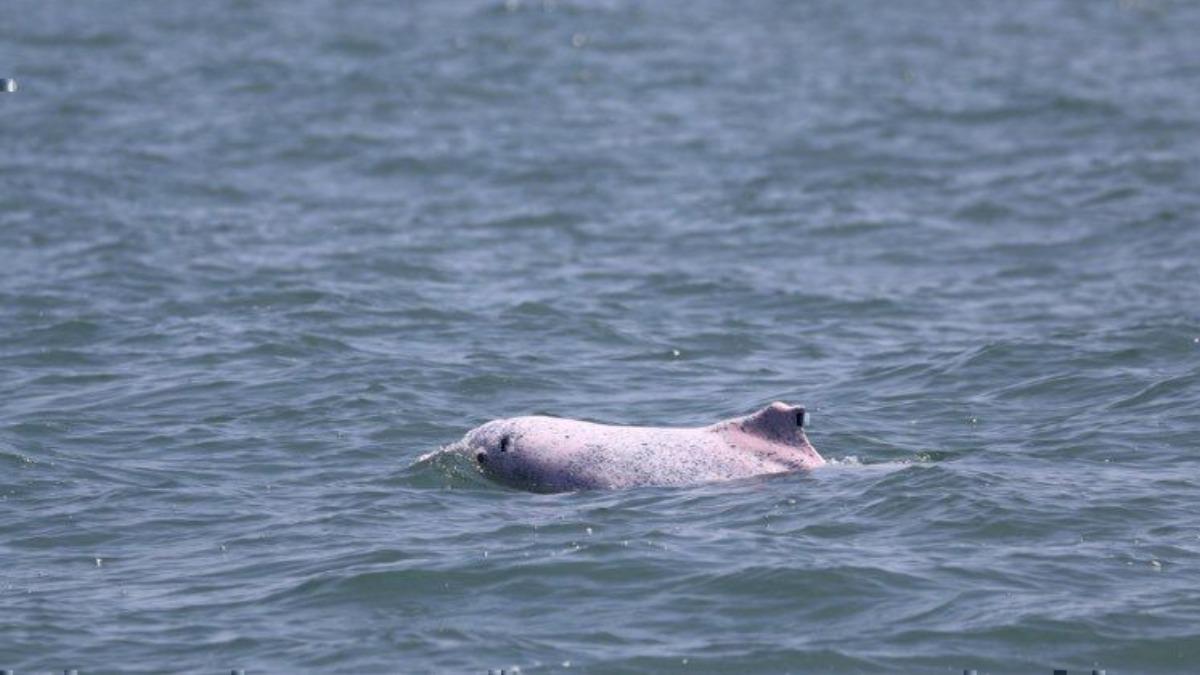
TAIPEI (TVBS News) — Environmental advocates sounded urgent alarms Thursday (July 17) over the precipitous decline of Taiwan's critically endangered Indo-Pacific humpback dolphins, known locally as Sousa chinensis (中華白海豚). At a press conference held at the National Taiwan University Alumni Association (台大校友會館), representatives from two environmental organizations presented troubling new data about the species' future. The Wild at Heart Legal Defense Association (台灣蠻野心足生態協會) and the Underwater Noise Association (水下噪音協會) hosted Canadian marine biologist John Wang (王愈超), who disclosed that the population has contracted to merely 45 to 50 individuals. Numbers have been steadily decreasing at an annual rate of 3% to 4% since monitoring began in 2002.
The marine biologist pinpointed accelerating coastal development along Taiwan's western shoreline as the primary driver of the species' decline. Wang detailed multiple threats including offshore wind farm construction, natural gas terminals, commercial fishing conflicts, and increasing underwater noise pollution that disrupts the dolphins' sensitive echolocation abilities. His research indicates that 90% of the remaining population must navigate through the busy waters near Taichung Port (台中港), central Taiwan's largest industrial harbor. The port's ongoing expansion projects have severely degraded critical habitat, compelling the dolphins to swim at unnaturally rapid speeds to avoid dangers. Perhaps most distressing, Wang noted that approximately 60% of observed dolphins display visible physical injuries, causing chronic pain and substantially reducing their already threatened lifespans.
Addressing potential conservation approaches, Wang firmly rejected captive breeding programs as a viable solution for the species' recovery. He explained that these dolphins maintain complex social structures and behavioral patterns that cannot be adequately reproduced in artificial environments. The researcher also documented numerous instances of illegal trawling operations in protected waters, emphasizing the extreme survival pressures these marine mammals face from human fishing activities. Robin Winkler, the American-Taiwanese founder of the Wild at Heart Legal Defense Association, struck a cautiously optimistic note amid the troubling findings, expressing his belief that Taiwan could potentially achieve a balance between renewable energy development, marine mammal conservation, and sustainable fishing practices.
The environmental advocacy group has maintained a long-standing partnership with Wang since 2006, achieving a significant conservation milestone when they successfully petitioned the International Union for Conservation of Nature (IUCN) to classify the Taiwanese population of Indo-Pacific humpback dolphins as critically endangered in 2008. The designation brought crucial international attention to the species' plight. The association continues to advocate for stronger protective measures while acknowledging Taiwan's complex developmental needs. They push for a more balanced approach that would allow both economic progress and the survival of this iconic marine species unique to Taiwan's western waters. ◼