








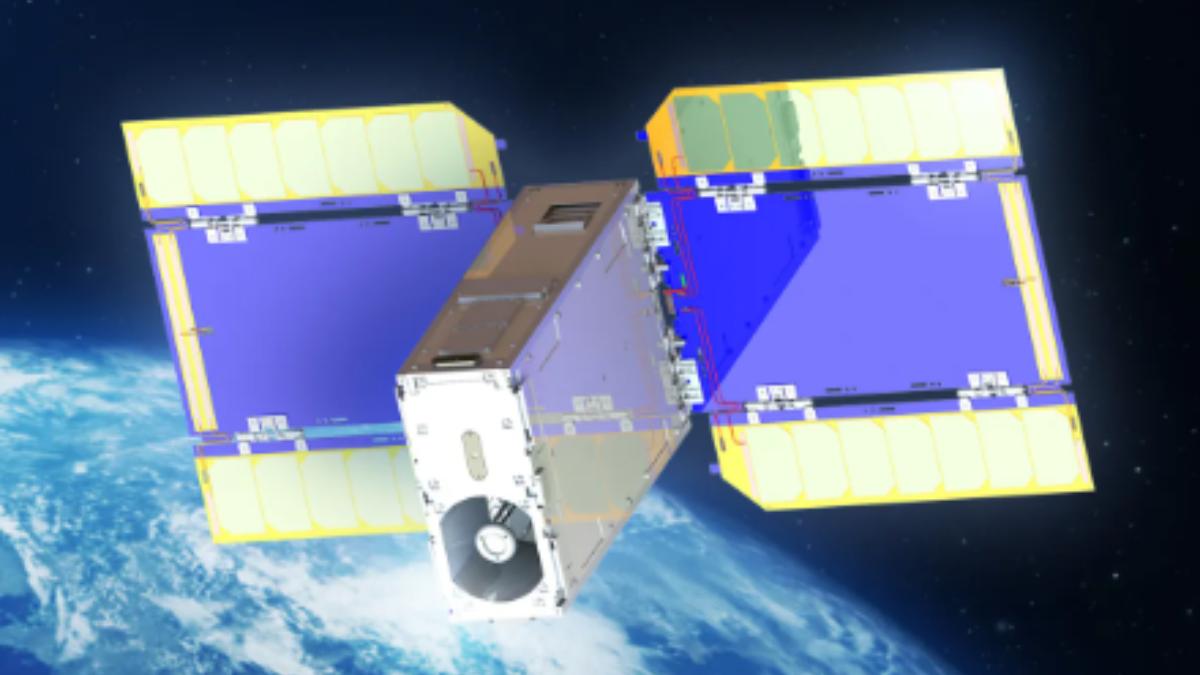
TAIPEI (TVBS News) — Taiwan Space Agency (國家太空中心) announced on Wednesday (Feb. 5) that the ONboard Globe-Looking And Imaging Satellite (ONGLAISAT, 旺來) satellite successfully completed 50 imaging operations following its deployment into orbit. The satellite, launched on Nov. 5, 2024, in the United States, was ejected into a low Earth orbit of 410 kilometers from the International Space Station (國際太空站) on Dec. 9.
The satellite's mission, which includes testing a Korsch Off-axis optical system, Complementary metal–oxide–semiconductor Time Delay and Integration (CMOS TDI) image sensors, and in-orbit JPEG 2000 image compression technology, has achieved a 100% success rate. TASA collaborated with the Intelligent Space Systems Laboratory, the University of Tokyo (ISSL), ArkEdge Space, and Space BD to develop the 6U satellite, measuring 30x20x10 centimeters, which is used to test a new optical payload design and image processing techniques.
Chan Chen-yu (詹鎮宇), project director, emphasized the cost-effectiveness of Cubesatellites like ONGLAISAT for experimenting with emerging space technologies. He pointed out that the ONGLAISAT project aims to verify the system feasibility for future ultra-high-resolution optical remote sensing satellites. The KT90 optical remote sensing payload, developed by TASA, marks the first time a Korsch Off-axis optical system has been used in satellite design.
In addition, the CMOS TDI image sensor, developed by Taiwan Semiconductor Research Institute, represents Taiwan's first successful indigenous TDI sensor, enhancing satellite self-manufacturing capabilities. The satellite's image compression technology optimizes storage and downlink bandwidth.